Wednesday, September 5, 2012

Dudes & Models of the Atom

There are several "dudes," famous chemistry folks that students need to be familiar with. These dudes (Democritus, Dalton, JJ Thompson, Millikan, Rutherford, Bohr, Heisenberg, De Broglie, and Planck) all did experiments and came up with different and improved atom models. The current model is the elctron cloud or quantum mechanical model which was formulated by Heisenberg and De Broglie.

Heisenberg & De Broglie came up with the current electron cloud model, but we draw Bohr's planetary model the most often because it easier to count the electrons.

Electrons are tricky because they move constantly and at high speeds. Heisenberg's Uncertainty Principle states that you cannot know both the speed and location of an electron - you can only know one - because measuring either one, changes the other. DeBroglie's wave theory helps explain why electrons sometimes act like particles and sometimes are compared to waves.

For more information about the evolution of the atomic model, check out this link.

Tuesday, September 4, 2012

Atoms and the Periodic Table

Atoms, or elements, are the smallest unit of matter. They retain their identity in chemical reactions and are combined to form compounds and everything in the universe.

Atoms have some basic parts. Protons and Neutrons are found in the nucleus and make up the atomic mass. To find the number of neutrons, you subtract the atomic number (number of protons) from the atomic mass number (protons plus neutrons).

Electrons are so tiny that they do not influence the atomic mass. They are found orbiting the nucleus in shells or orbitals. Atoms are neutral so the number of protons equals the number of electrons.


We talked about the periodic table on Friday. Mendeleev deisgned the periodic table by looking at the properties of elements on cards and arranging them different ways until he got a system that worked. No one told him how to do it, he just did it until it worked. He even left spaces for elements that were discovered in his lifetime. (More info about Mendeleev) His periodic table was set up according to atomic mass number. The current table, altered slightly by Moseley, is organized by atomic number (number of protons).

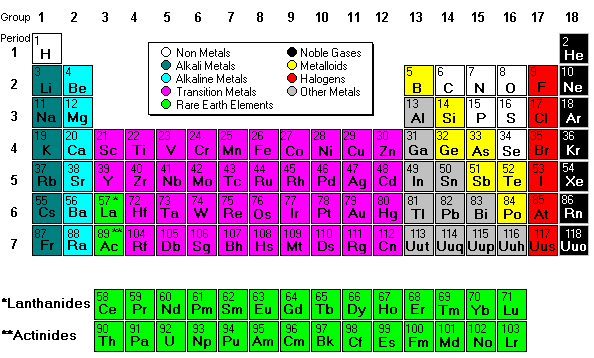
Next we discussed regions of the periodic table, colored them, and labeled them. Periods are horizontal rows (periods go at the end of a sentence) and there are 7 periods. There are 18 groups or families (vertical columns) and a few of them have special names. This a pretty excellent diagram. This website gives a lot of helpful information.


We finished class by playing a quick game Guess Who.

Saturday, August 25, 2012

Percent Composition

Percent composition is just like determining your grade - the amount you got divided by the the whole amount. 


With compounds, you find the mass of a particular element and divide it by the mass of the whole compound. So if you wanted to know the percent composition of oxygen in water, you would take the mass of oxygen and divide it by the mass of water. 

We practiced some basics and the students began a paper forensics investigation that is using percent composition to determine which passengers in a plane crash are which, which passenger is responsible for the plane crash, and more. 

Wednesday, August 22, 2012

Conversions - Dimensional Analysis

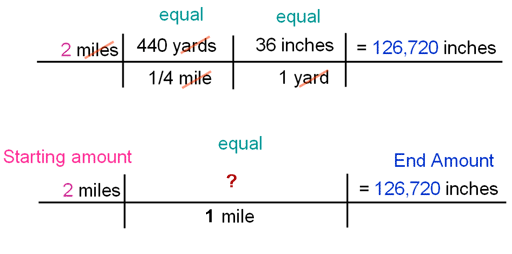
Conversions, or dimensional analysis, are used to change one unit to another. This is really useful when converting to metric units, but is essential to chemistry in terms of mole conversions. Setting up conversions is a skill so we started with learning the format. There are plenty of how to videos out there on the internet for anyone needing a tutorial.

We practiced conversions with some of the crazy things people do to get in the Guinness Book of World Records - like longest ear hair, skinniest waist, tallest man, etc. I think the one the kids thought was the weirdest was the lady who can pop her eyes out 12mm.

Check out more crazy records here!

Next week we will be learning how to do conversions with moles!

Thursday, August 16, 2012

Hazard Diamonds - Safety at a glance!

NFPA Hazard Diamonds

The NFPA 704 fire diamond (or hazmat diamond) is described in NFPA Standard 704, maintained by the National Fire Protection Association. The system identifies four key hazards (health (blue), flammability (red), instability (yellow), and special (white)) and their degree of severity. Hazard severity is rated numerically, ranging from 0 (minimal) to 4 (severe).


The hazard diamond is useful because it allows emergency personnel to quickly and easily identify the risks posed by hazardous materials and is  useful to determine what, if any, special equipment should be used, procedures followed, or precautions taken during an emergency response. (Summarized & more information here.)

Want to make your own customizable hazard diamond? Click here. Why does this feature exist? So people can make easily identifiable hazard diamonds for any chemical they have on hand. 

Friday, August 10, 2012

Fall 2012 - Welcome Back!

Greetings students, parents, and guardians.

Welcome to a new school year with Ms Jancaitis! This blog has been set up to connect students, parents, and guardians with the chemistry class.

 At Open House or in class, each student will receive a course syllabus. The course syllabus outlines what the course will be like, what topics will be covered, and course expectations. It also contains contact information. There will be a quiz on this syllabus on Thursday.

Our first unit will cover lab safety and equipment. Each note packet comes with the safety rules and contract. The safety rules and contract need to be read and signed by both the student and parent guardian. The safety rules are rules designed to keep the classroom safe and orderly to maximize learning and prevent accidents and injuries. These rules need to be studied because there will be a safety test on Monday or Tuesday and infractions of these rules can lead to disciplinary action as well as low assignment grades. A contract holds students accountable for the items that are broken if the student is acting a manner that is unsafe for themselves or those around them.


Please have these papers signed and returned by Monday the 20th. Students not returning signed safety rules and safety contracts will not be able to participate in labs and activities until the contracts are signed and returned.

Monday, December 5, 2011

What is a mole?

Today, we started talking about moles. Moles are used to count atoms. There are 22,000,000,000,000,000,000 quintillion atoms in a grain of sand and even counting grains of sand is a pain. Because atoms are so tiny, we use the mole to estimate.

There are 6.02 x 10 ^23 molecules in one mole. That's a whole lot. This is our new favorite number because it needs to be memorized. We practiced converting from moles to molecules.

Next we discussed molar mass. Molar mass = 1 mole and it also equals atomic mass from the periodic table. To find the molar mass of carbon dioxide you find the mass of carbon and two oxygens and add them together. Finding molar mass is not difficult unless the molecule has tricky subscripts (which we have been practicing).

Friday, December 2, 2011

Le Chatlier

Students learned about reaction rates and how to increase them. They also learned about reversible reactions and how Le Chatlier's principle influences shifts of equilibrium in reversible reactions.

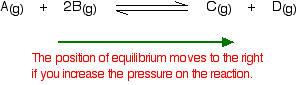
Basically as you apply a stress to a system, the system will shift in response to the stress. If you add one of the molecules it will shift away from that molecule. If you take away a molecule, it will shift towards it to make more. Heat works the same way.

Pressure is the tricky one. If pressure is applied to an equilibrium, then the reaction will shift to the side that has the least amount of molecules (count the coefficients).

Wednesday, November 30, 2011

Reaction Rate Basics

Reaction Rates are affected by a few things. Without telling them the point, the students had a quick demo where they had to dissolve sugar cubes the fastest. 

The things that speed up reactions are:
  • Temperature - warmer is faster
  • Surface Area - small pieces have more surface area
  • Concentration - the more water, the faster sugar will dissolve
  • Catalyst - lowers the activation energy and speeds up the reaction
  • Agitation - shaking or stirring increases the frequency of collisions.

Monday, November 28, 2011

Reaction Types

We started by talking about the simple definition of the terms, what the probably products and reactants are and went over a basic formula for the reaction types the students need to be familiar with.

Reaction Types include:
  • synthesis
  • decomposition
  • singe replacement
  • double replacement
  • combustion
  • endothermic
  • exothermic
  • oxidation-reduction
  • neutralization
After discussing the basics, we drew cartoons of stick men and women going on dates to show how atoms move around in the simpler reactions. The picture posted is someone else's version of single replacement (see the one guy switches with the other). For more help with this, check here.

 Homework is to finish the Benchmark Review Sheet and J and I on the orange homework sheet